
Book a meeting

AI agents

How to Handle High Call Volumes and Meet SLAs Effectively

High call volumes put unnecessary strain on your support teams, which leads to missed SLAs, frustrated customers and overwhelmed staff.

Calls waitingSLAself-serve
The short answer

A portal relieves pressure on your support function by letting customers serve themselves for common queries. It is a win on both sides: they get an answer sooner, and your team gets its time back for the calls that need a person.

The problem, and the way out of it

Failing to meet SLAs because of high call volumes.

The problem

Every call treated the same

The constant pressure on your customer service teams to manage every incoming call — no matter how simple — means the high-value, complex enquiries are not getting the attention they deserve. Meanwhile customers wait on hold for routine queries that could have been handled faster another way.
The solution

A customer facing portal

A portal relieves pressure on your support function by letting customers serve themselves for common queries. It is a win on both sides: they get an answer sooner, and your team gets its time back for the calls that need a person.

How we can help

What we would actually do.

Four things, and the first one usually pays for the rest.

1234
Cut down on call volumesCustomers find answers themselves, on their terms, whenever they need them.
Boost customer satisfactionMany people would rather solve something on their own than wait on hold for a routine enquiry.
Free up your support teamsThey focus on the high-value calls that need real depth, which is a better use of the same people.
Maintain and even exceed SLAsService delivery gets more streamlined and wait times come down, which is what the SLA actually measures.

Immediate benefits

What changes straight away.

Fewer routine calls

Shorter wait times

Better use of your team

The original

This page, as the one-pager it came from.

Everything above is on this sheet. It’s a nicely made thing and some people would rather forward a PDF than a link, so it’s here too - no form, nothing gated.

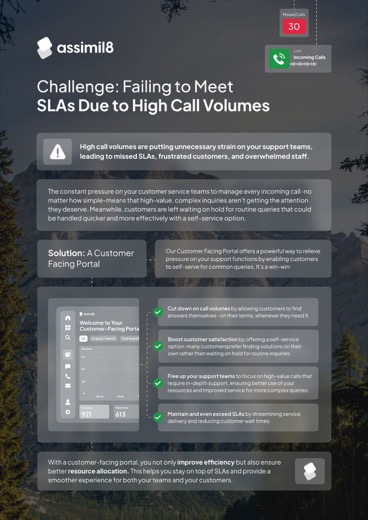
The How to Handle High Call Volumes and Meet SLAs Effectively one-pager

Where this goes next

Customer facing portals

This question sits inside a bigger piece of work. If it’s the one bothering you, that page is where the detail is.

Before you book

The questions this raises.

Is the phone the reason your SLAs keep slipping?

High call volumes put unnecessary strain on your support teams, which leads to missed SLAs, frustrated customers and overwhelmed staff.

What causes it?

The constant pressure on your customer service teams to manage every incoming call — no matter how simple — means the high-value, complex enquiries are not getting the attention they deserve. Meanwhile customers wait on hold for routine queries that could have been handled faster another way.

What does assimil8 do about it?

A portal relieves pressure on your support function by letting customers serve themselves for common queries. It is a win on both sides: they get an answer sooner, and your team gets its time back for the calls that need a person.

What changes first?

Fewer routine calls.

Do I have to fill in a form to read this?

No. The whole one-pager is on this page, and the original PDF is there to download without giving us anything.

If this is your problem

Tell us how it works at the moment.

A customer-facing portal doesn’t just improve efficiency — it changes where your people spend their time. That is what keeps you on top of SLAs and makes the experience better at both ends.

Send it over

Where shall we send it?

Name, email and a number, and it’s with you in a minute.